Planetary Formation
See how the Earth is made
Our Earth is neither the first nor will be the last one in this solar system.
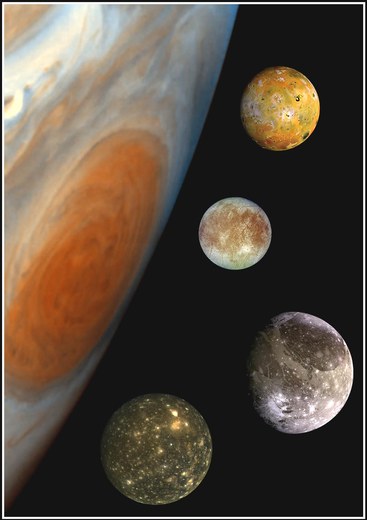
Io, Europa, Ganymede, Callisto, Titan, Triton, and Mars may be stages of one kind of planet. Earth is the living stage. Venus and Mercury are worlds that already finished that cycle. The idea was first posted here in 2015.
The Great Red Spot is a storm. If a new world is starting there, it would sit under the weather, not in the clouds we can see. Earth’s age, 4.54 billion years, divided by the eight worlds from Io to Earth is about 567 million years. That number is arithmetic. This is a hypothesis, not a proof. The pages below take each world in order.
The sequence at a glance
Eight worlds, a proposed start, two remnants.
Proposed beginning
Great Red Spot
A lid over a possible start — not a planet in the clouds
Stage 1
Io
Hadean-like fire — a crust that never sits still
Stage 2
Europa
The first ocean, under a young lid of ice
Stage 3
Ganymede
An organized interior — a field of its own
Stage 4
Callisto
A quiet ice lid — still, cratered, outside the tight dance
Stage 5
Titan
The first thick air — nitrogen, rain, lakes
Stage 6
Triton
A thin leftover sky
Stage 7
Mars
A compact world of continental class
Stage 8
Earth
The living chapter — oceans, air, life
Prior remnant
Venus
A spent Earth-sized world
Prior remnant
Mercury
A core with almost no coat left
How to read this site
“Looks like a stage of Earth” is a comparison. “Is the next Earth” is the hypothesis. Those sentences are kept apart. Temperature, tides, and solvent can hide a real stage and fake one. Measured facts survive that difference. Identity does not.
Watch the Spot through Mercury · Walk the sequence · See the Spot · Read the notes